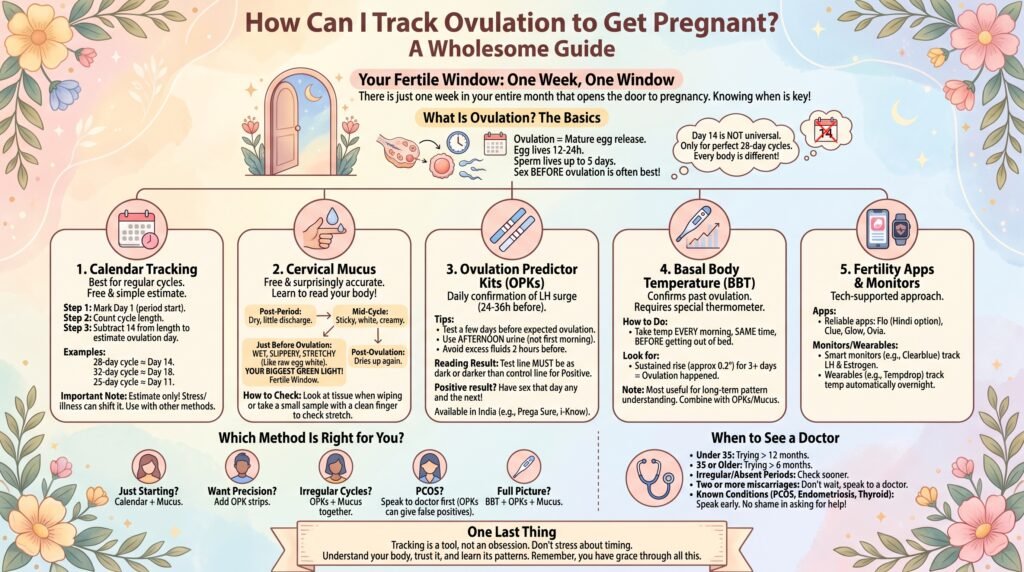
How Can I Track Ovulation to Get Pregnant?
There is just one week in your entire month that opens the door to pregnancy. One window. And everything about trying to conceive comes down to knowing when that window is.
Here are 5 reliable ways to track it.
- Calendar Tracking
- Cervical Mucus
- Ovulation Predictor Kits
- Basal Body Temperature
- Fertility Apps and Monitors
First, What Is Ovulation?
Ovulation is when your ovary releases a mature egg. That egg survives for only 12 to 24 hours. Sperm can survive inside the body for up to 5 days . which is why having sex in the days before ovulation is often more effective than the day of.
And day 14 is not a universal rule. That only applies if you have a perfect 28 day cycle. Every woman’s body is different.
Calendar Tracking
Best for women with fairly regular cycles. Free and simple to start with.
How to do it
Step 1 Mark the first day of your period as Day 1.
Step 2 Count the days until your next period, that’s your cycle length.
Step 3 Subtract 14 from your cycle length to estimate ovulation day.
28 day cycle — ovulation around Day 14
32 day cycle — ovulation around Day 18
25 day cycle — ovulation around Day 11
Important note This is an estimate only. Stress, illness or hormonal changes can shift ovulation. Use this alongside other methods for better accuracy.
Cervical Mucus
Free and surprisingly accurate once you learn to read it.
Throughout your cycle your discharge changes texture based on where you are in your cycle…
Right after your period Dry, little to no discharge.
Mid cycle approaching ovulation Sticky, white or creamy.
Just before ovulation Wet, slippery and stretchy. Like raw egg white. This is your biggest green light. When you see this you’re in your fertile window.
After ovulation Dries up again.
How to check Each time you use the bathroom look at the tissue when you wipe or take a small sample with a clean finger and see if it stretches.
Ovulation Predictor Kits
Good for women who want clear daily confirmation. Available at most medical stores and online.
These kits detect a hormone surge that happens 24 to 36 hours before ovulation. When you get a positive result ovulation is about to happen.
How to use
Test timing Start testing a few days before your expected ovulation.
Use afternoon urine Not first morning urine, the hormone is better detected mid day.
Avoid excess fluids Don’t drink large amounts of water for about 2 hours before testing as it can dilute the result.
Reading the result The test line needs to be as dark or darker than the control line to be positive.
In India Prega Sure OPK strips and i-Know ovulation kits are widely available on Amazon, Flipkart and at medical stores.
When you get a positive Have sex that day and the next day for the best chance.
Basal Body Temperature
Best for confirming that ovulation has already happened. Requires a special basal thermometer. It’s available for around ₹500 to ₹1500.
After ovulation a hormone called progesterone causes a small rise in your resting body temperature, about 0.2 degrees, that stays up until your next period.
How to do it
Every morning before getting up Take your temperature at the same time each day before moving or getting out of bed.
Record it Use an app like Fertility Friend or Flo to track your readings.
Look for the shift A sustained rise over 3 or more days means ovulation has happened.
Important note This method tells you ovulation already happened. It’s most useful for understanding your pattern over a few months. Combine it with OPKs or cervical mucus for a fuller picture.
Fertility Apps and Monitors
Good for women who want a tech supported approach.
Apps Flo, Clue, Glow and Ovia are all reliable. Flo is especially popular in India and has a Hindi language option.
Smart monitors Devices like the Clearblue Advanced Digital Ovulation Test detect both LH and estrogen giving you a wider picture of your fertile days. More expensive but more detailed.
Wearables Devices like Tempdrop track your temperature automatically overnight removing the need to wake at the same time every day.
Which Method Is Right for You?
Just starting to try Calendar tracking and cervical mucus is a great start.
Want more precision Add OPK strips alongside.
Irregular cycles OPKs and cervical mucus together work well.
Have PCOS Speak to your doctor before using OPKs, they can give false positive results with PCOS.
Want the full picture Basal body temperature, OPKs and cervical mucus together give you the most complete information.
When to See a Doctor
Under 35 If you’ve been trying for more than 12 months.
35 or older If you’ve been trying for more than 6 months.
Irregular or absent periods Worth checking sooner.
Two or more miscarriages Please don’t wait to speak to a doctor.
Known conditions If you have PCOS, endometriosis or thyroid issues speak to your doctor early.
There’s no shame in asking for help. The earlier you get answers the more options you have.
One Last Thing
Tracking ovulation is a tool, not something to obsess over. Many women find that the more they stress about timing the harder the journey feels.
Use these methods to understand your body better. Trust it. Learn its patterns. And remember you have grace through all this.